News
35th Annual Meeting of the Society of Virology in Heidelberg
From 17 to 20 March 2026, the 35th Annual Meeting of the Society for Virology took place at Heidelberg University’s Life Science Campus. The conference offered fascinating insights into the latest developments in virology – ranging from basic research and clinical issues to new technologies. Lisa and Max attended with posters on the transmission of herpes simplex virus 1 via cell-cell contacts and multispectral microscopy of the assembly of influenza A virus, and were able to present their research during many stimulating discussions. As in previous years, the conference dinner, followed by a party, provided an opportunity to exchange ideas in a relaxed atmosphere.


30 years Bonn Forum for Biomedicine (BFB)
Katharina, as a new board member of the Bonn Forum for Biomedicine, is giving a talk entitled: “A viral journey: tracing infection by advanced microscopy”. Lisa and Max are presenting posters on their work into the transmission of herpes simplex virus 1 via cell-cell contacts and on multispectral microscopy of the assembly of influenza A virus.
Review on expansion microscopy published in npj Viruses – Why is expansion microscopy ideally suited to virological research?
Our first publication from the lab highlights expansion microscopy as a powerful tool for the nanoscale investigation of viruses and virus-host interactions. The method enables up to ten times higher resolution than conventional light microscopes and opens up new insights into virion morphology, viral replication and the biology of viral infections. In our review, we present the fundamentals of the technique and summarise the first promising applications in virology research.
Congratulations to the authors Lisa Övermöhle, Maximilian Baum, Rohan Bhatia and Karin Byskata!

For the full article, click here: Visualising viral interactions and mechanisms at the nanoscale with expansion microscopy
We’ve moved!
In December 2025, after a two-and-a-half-year set-up phase, we were finally able to move into our new lab at the Institute of Microbiology and Biotechnology. With the active support of the whole group and a van hired from the university, we moved the majority of our laboratory equipment to the new location ourselves. We would like to thank the Clausius Institute for Physical and Theoretical Chemistry for their hospitality and support over the past few years.
The move marks an important milestone for our research group. In the new environment, we are able to carry out genetic engineering work with biosafety level 2 viruses, and cell culture, microscopy as well as the cryopreservation of viruses and cell lines are all brought together in one central location.
A particular highlight of our new infrastructure is the state-of-the-art wide-field microscope. Thanks to an integrated incubation chamber and specialised high-performance objectives, it is ideally suited to demanding live-cell studies and opens up new possibilities for the dynamic analysis of biological processes in real time.
2025 graduates
Congratulations to our students on successfully completing their Bachelor’s or Master’s degree this year!
- Anne Sturmhöfel (M.Sc. Mikrobiologie)
- Emily Schäfer (B.Sc. Biologie)
- Lovis Rettberg (B.Sc. Biologie)

Mini-symposium "From Imaging to Function: Advanced Light Microscopy in Biophysical Chemistry" on 26 September 2025
As part of the mini-symposium at the Clausius Institute at the University of Bonn, Katharina is giving a talk on her research into RNA-RNA interactions in an attenuated live influenza vaccine. She has collaborated with AstraZeneca on this project.
The programme as a whole is a wonderful illustration of the diverse and exciting prospects offered by the field of biophysical chemistry.
Welcome, Karin Byskata!
Karin is joining us this summer for two months as an exchange student from the Karolinska Institute. She will be learning high-resolution microscopy techniques such as expansion microscopy and AiryScan confocal microscopy. She will be assisting Lisa with her PhD project, in which Lisa uses these techniques to characterise the transmission pathways of herpes simplex viruses between cells. Herpes simplex viruses are large, very ancient DNA viruses that have co-evolved with their hosts over millions of years and can infect neurons.
The research placement is supported by Erasmus+ and the NeurotechEU programme, an alliance of nine European universities in the field of brain research and technologies.
Good luck with your upcoming PhD at the Karolinska Institute, Karin!
34th Annual Meeting of the Society for Virology (GfV)
The GfV invites to its 34th Annual Meeting in Hamburg: alongside presentations on various areas of virology, the conference offers keynote talks, workshops and networking opportunities. A particular highlight are the jGfV sessions for young virologists.
Lisa and Max will be presenting posters showcasing the initial findings from their PhD theses.
BFB Annual Meeting 2025
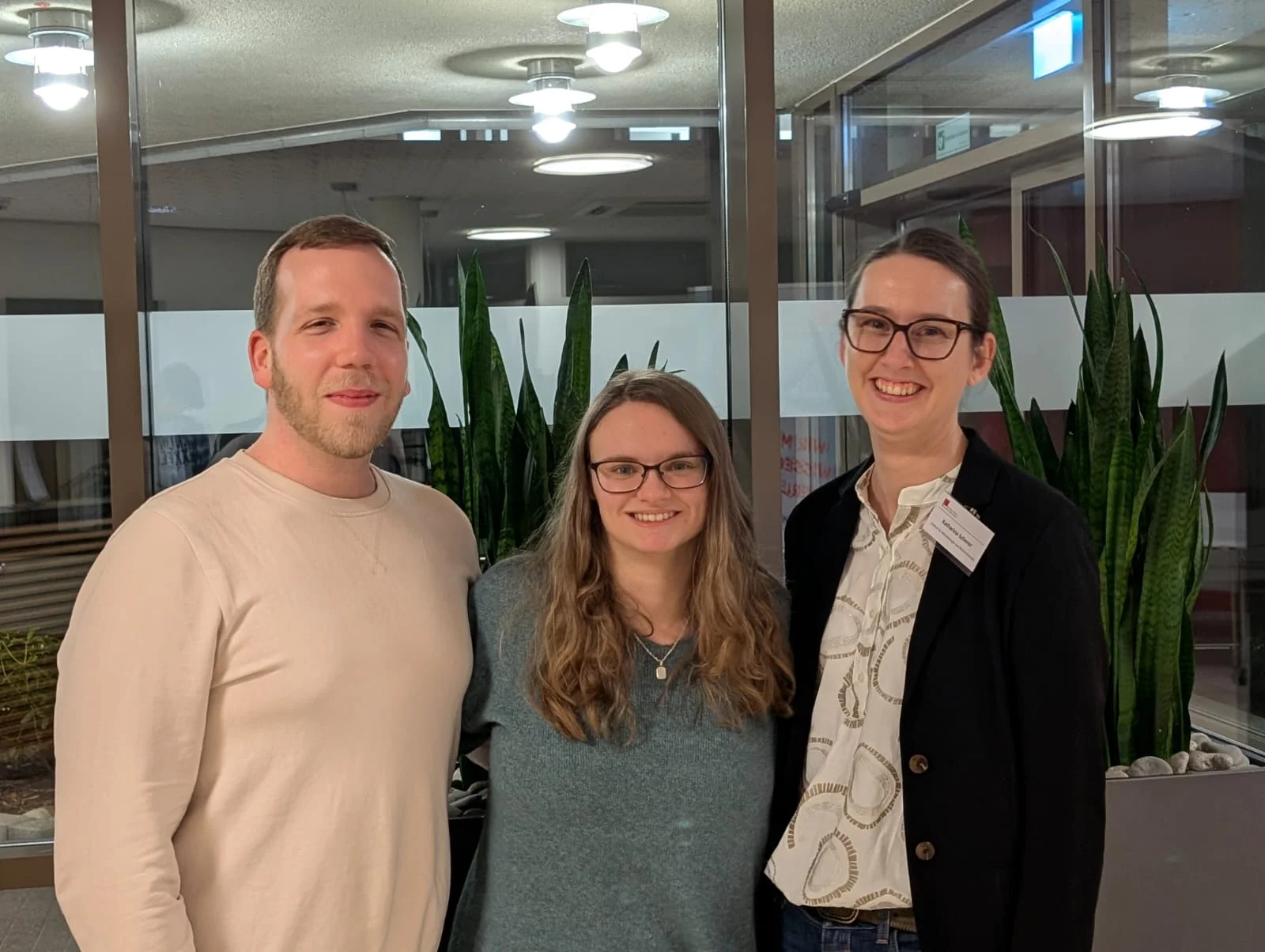
Our first joint conference as a working group! Katharina has been accepted as a new member of the Bonn Forum for Biomedicine (BFB) and elected to the executive committee.
The BFB is a network that brings together researchers in the life sciences in Bonn, and we are proud to be new members!
2024 graduates
Congratulations to our students on successfully completing their Bachelor’s or Master’s degree this year!
- Maximilian Baum (M.Sc. Mikrosbiologie)
- Simon Hutterer (B.Sc. Biologie)
- Laura Nienaber (B.Sc. Biologie, extern)
An exciting visit to the microbiology laboratory with the Scherer Lab
In December 2024, we were delighted to welcome a very special group: Year 10 students from the ‘Biotechnology’ course, accompanied by their teachers Markus Heinen and Karl Komander from the Siebengebirgsgymnasium in Bad Honnef.
Full of enthusiasm and curiosity, the young researchers set about preparing various samples in the microbiology practical rooms under expert guidance. In the morning, they had the opportunity to observe microorganisms such as yeasts, bacteria and animal cells under the microscope, thereby immersing themselves in the fascinating world of the tiniest living organisms. The lunch break was not wasted either. Equipped with RODAC plates, the students roamed through Poppelsdorf, eagerly collecting samples of whatever they could get their hands on. The day was rounded off with a visit to the neighbouring Institute of Physical Chemistry: using high-tech laser microscopes, the students were able to examine samples such as mouse brains and organoids in detail.
Feedback from the 15-year-old students on their day in the lab:
“I thought the trip was an interesting experience. The best bit was the hands-on work with the microscopes.”
“It was very varied and I liked the fact that we didn’t just have to listen.”
“I liked the laser microscope and the mouse brain.”
“There was loads to try out, which I really enjoyed.”


Advanced module in the microbiology master programme
Since the winter semester 23/24, our research group has been offering an advanced module as part of the MSc in Microbiology. In the 4- or 6-week laboratory module MIB79 - "Microscopy of Viral Infections", interested students can gain detailed insights into the highly complex processes involved in viral replication, such as the assembly and transport of new viral particles, using modern, high-resolution fluorescence microscopy techniques.
Junior research group within the NRW Return Programme
The research group of Dr Katharina Scherer will commence its work at the Institute of Microbiology and Biotechnology in March 2023. It will conduct research into host-pathogen interactions involving respiratory viruses, utilising state-of-the-art methods of high-resolution fluorescence microscopy. Katharina’s research programme is receiving €1.25 million in funding as part of the NRW Return Programme run by the State of North Rhine-Westphalia.
Please find more information here: NRW Rückkehrprogramm 2022